


Get 2025 Most Reliable VMware 2V0-17.25 Training Materials
The Realest Study Materials 2V0-17.25 Dumps
NEW QUESTION # 20
Which tasks can be automated using vRealize Orchestrator in a vSphere environment?
- A. Integrating custom scripts or workflows with vCenter Server events
- B. Managing network port groups for distributed switches
- C. Deploying new VMs from templates
- D. Performing daily Windows OS patches inside VMs
Answer: A,B,C
Explanation:
vRealize Orchestrator can automate VM deployments, custom scripts, and network changes. Patching OS-level components (B) typically relies on separate patch management tools that may integrate with Orchestrator, but it's not the primary function out of the box.
NEW QUESTION # 21
An administrator recently incorrectly deployed a new isolated VI workload domain within an existing VMware Cloud Foundation (VCF) instance.
How can the administrator reconfigure the VI workload domain to share the SSO domain from the management workload domain?
- A. From the VI workload domain vCenter Server instance, add the management domain SSO and remove the isolated SSO.
- B. From the SDDC Manager console, migrate the VI workload domain to the management domain.
- C. A new VI workload domain must be created through SDDC Manager.
- D. From the management domain vCenter Server instance, use the rsautil command to add the VI workload domain to the management domain.
Answer: C
Explanation:
Comprehensive and Detailed Explanation From Exact Extract:
According to VMware Cloud Foundation documentation, once a VI workload domain has been deployed as an isolated domain (with its own SSO), it cannot be reconfigured after deployment to join the management domain's SSO domain. The official guidance states that the only supported approach is to delete the incorrectly configured VI workload domain and create a new one through SDDC Manager, ensuring it is properly configured to share the SSO domain with the management domain during the deployment process. There is no supported process to convert or migrate an existing isolated SSO VI workload domain to a shared SSO configuration after deployment.
NEW QUESTION # 22
Which of the following considerations apply when deploying NSX for micro-segmentation in a vSphere environment?
- A. vSphere HA must be disabled for NSX to function
- B. Distributed Firewall rules can be applied at the virtual NIC level
- C. Proper IP addressing and VLAN design for NSX management and VXLAN traffic
- D. Using Guest Introspection services for offloaded antivirus scanning
Answer: B,C,D
Explanation:
NSX micro-segmentation uses distributed firewall rules at vNIC level (A), requires dedicated network design (C), and integrates with Guest Introspection for security (D). HA does not need to be disabled (B).
NEW QUESTION # 23
DRAG DROP
Arrange the steps in the correct order to generate a performance report in Aria Operations.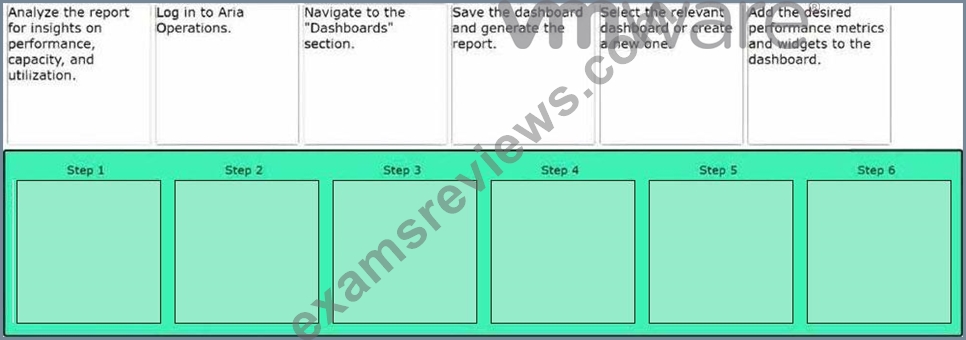
Answer:
Explanation: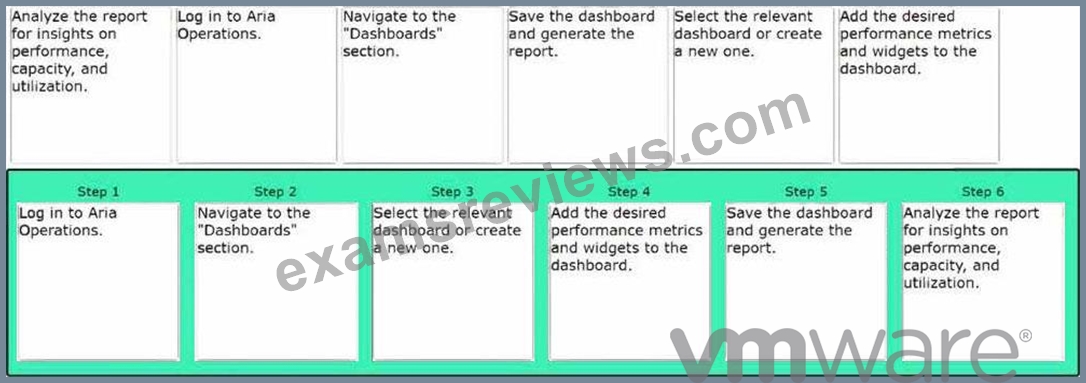
NEW QUESTION # 24
While troubleshooting a vSphere HA c luster issue, an administrator observes that a host is in the Network Isolated state. The host is unable to ping the configured isolation address and cannot access any other vSphere HA agents.
Which step would resolve this issue while minimizing downtime for running virtual machines (VMs)?
- A. Reconfigure the isolation addresses to ensure the host can ping the default gateway or other configured IPs.
- B. Reconfigure the host's HA agent to bypass the isolation check and allow VM operations to continue.
- C. Power off all VMs on the isolated host, remove the host from the cluster, and add it back after the network is fixed.
- D. Restart the vSphere HA services on the isolated host to trigger the election of a new primary agent.
Answer: A
Explanation:
Ensuring the host's isolation addresses include reachable targets (such as the default gateway) allows the HA agent to detect network connectivity correctly without taking action on running VMs, resolving the isolation state with minimal disruption.
NEW QUESTION # 25
In VMware storage design for a vSphere environment, which of the following are commonly used datastore types?
- A. CIFS shares for hosting VM disks
- B. vSAN datastores across cluster nodes
- C. NFS datastores over IP network
- D. VMFS datastores on block storage
Answer: B,C,D
Explanation:
VMware supports VMFS (on block storage), NFS (file-based), and vSAN (distributed storage). CIFS (option C) is typically not used to host VMware virtual disks.
NEW QUESTION # 26
Which VMware license edition typically provides the most comprehensive set of features, including DRS, HA, and vMotion?
- A. Foundation
- B. Standard
- C. Enterprise Plus
- D. Essentials
Answer: C
Explanation:
Enterprise Plus is the top-tier edition that generally includes advanced features such as Distributed Resource Scheduler (DRS), High Availability (HA), and vMotion, among others.
NEW QUESTION # 27
Which VMware solution provides insight into resource usage trends and capacity analytics, enabling predictive optimization of vSphere environments?
- A. vSphere Auto Deploy
- B. vCenter Server High Availability
- C. vRealize Operations Manager
- D. vRealize Log Insight
Answer: C
Explanation:
vRealize Operations Manager offers advanced analytics for capacity planning, performance monitoring, and trend analysis. Log Insight focuses on log aggregation and analysis, Auto Deploy automates ESXi provisioning, and vCenter HA provides high availability.
NEW QUESTION # 28
Which of the following networking features or approaches can help ensure minimal packet loss and stable throughput for latency-sensitive VMs?
- A. Migrating vCenter Server to an isolated VLAN
- B. Enabling Network I/O Control (NIOC) on a distributed switch
- C. Using VMXNET3 adapters within guest VMs
- D. Ensuring the physical switch supports and matches MTU settings for Jumbo Frames
Answer: B,C,D
Explanation:
NIOC (A) can prioritize critical traffic, VMXNET3 (B) is VMware's optimized virtual NIC, and consistent Jumbo Frame configuration (D) prevents fragmentation. Isolating vCenter (C) may help security but doesn't inherently improve latency for production VMs.
NEW QUESTION # 29
An administrator's passwords for their NSX 'root', 'admin', and 'audit' accounts in the Cloud Foundation management domain expired. The administrator logged into the NSX Manager console and changed the passwords for all three accounts. The passwords are now showing a status of
"Disconnected" in the SDDC Manager UI.
- A. In SDDC Manager, navigate to Password Management and select the account with the password with a "Disconnected" status, click the vertical ellipsis (three dots), and click Remediate.
- B. In SDDC Manager, navigate to Password Management and select the account with the password with a "Disconnected" status, click the vertical ellipsis (three dots), and click Sync.
- C. In order to correct this issue, how can SDDC Manager be updated with the new passwords?
- D. In SDDC Manager, navigate to Password Management and select the account with the password with a "Disconnected" status, click the vertical ellipsis (three dots), and click Rotate.
Answer: D
Explanation:
To resolve the issue of disconnected accounts in SDDC Manager after password changes, the administrator must navigate to the Password Management section in the SDDC Manager UI. From there, the administrator can select the affected account, click the vertical ellipsis (three dots), and choose Update to enter the new password for that account, ensuring SDDC Manager is synced with the correct credentials.
NEW QUESTION # 30
An administrator is tasked with deploying a new VMware Cloud Foundation (VCF) instance.
The management domain is designed to be created with three virtual distributed switches (VDS) configured as follows:
- VDS1 - used for management and vMotion traffic
- VDS2 - used for vSAN traffic
- VDS3 - used for NSX Overlay traffic
What action would the administrator take to deploy the designed configuration?
- A. vSphere Distributed Switch Profile 2 must be selected in the VCF Deployment parameter workbook.
- B. A JSON file must be prepared with the defined configuration and used to run the bring-up process.
- C. The ESXi hosts have to be configured with twelve physical NICs to ensure redundancy.
- D. The design must be changed to ensure vSAN and NSX overlay traffic are on the same VDS.
Answer: B
NEW QUESTION # 31
How do virtual machine (VM) storage policies in a VMware vSphere environment contribute to optimizing resource utilization, ensuring data availability, and meeting application-specific requirements?
- A. By guaranteeing storage IOPs for a particular virtual machine
- B. By defining and enforcing storage requirements, such as performance, availability, and redundancy
- C. By regulating and optimizing storage traffic between virtual machines
- D. By streamlining the process of automating virtual machine backups
Answer: B
Explanation:
VM storage policies let you specify requirements like performance tiers, redundancy levels, and availability SLA, and vSphere enforces these rules against underlying storage capability profiles to optimize resource usage and meet application needs.
NEW QUESTION # 32
Which technology is primarily used to separate traffic and provide Layer 2 isolation in a vSphere virtual network environment?
- A. VMware Tools
- B. VLAN tagging
- C. Jumbo frames
- D. NIC teaming
Answer: B
Explanation:
VLAN tagging is used to isolate traffic at Layer 2 within virtual switches, ensuring network segmentation and security.
NEW QUESTION # 33
How can an administrator ensure that certain VMs run on separate hosts for availability or licensing reasons?
- A. Enable HA Admission Control
- B. Create a Resource Pool with a high share value
- C. Configure Storage vMotion to relocate disks
- D. Use VM-VM Anti-Affinity rules in DRS
Answer: D
Explanation:
VM-VM Anti-Affinity rules in DRS direct VMs to not run on the same host. A Resource Pool with a high share value does not prevent co-location, and Storage vMotion or HA Admission Control do not specifically separate VMs across hosts at runtime.
NEW QUESTION # 34
Which is the appropriate first action to take to resolve dropped network packets on an ESXi host?
- A. Enable Storage I/O Control
- B. Migrate VMs to another data store
- C. Increase the CPU and memory allocation for VMs
- D. Check physical network switch configuration
Answer: D
Explanation:
Dropped network packets are often caused by misconfigurations or issues at the physical network layer.
Checking the physical network switch configuration is the first step to ensure that the network settings, such as VLANs, uplinks, and port configurations, are correctly set up. This ensures proper connectivity and traffic flow for the ESXi host and the VMs.
NEW QUESTION # 35
An administrator is tasked with deploying a new, highly-available application on a VMware Cloud Foundation (VCF)-based private cloud. The new application will include both virtual machines and containers.
Which two components of VCF could the administrator use to complete the task? (Choose two.)
- A. NSX
- B. Aria operations
- C. HCX
- D. Supervisor
- E. Aria Suite Lifecycle
Answer: A,D
Explanation:
NSX provides the networking, security, and load-balancing services needed for high availability, while vSphere Supervisor enables Kubernetes integration alongside VMs, allowing you to run and manage containerized workloads on the same platform.
NEW QUESTION # 36
A virtual private cloud administrator is regularly tasked to provision and manage new application workloads with dedicated subnets.
Which two capabilities of VMware Cloud Foundation (VCF) can be used to alleviate the workload of the administrator with minimal interaction with the networking team? (Choose two.)
- A. Use of NSX overlay networks.
- B. Use vSphere Resource Pools to allocate networking resources to different applications.
- C. Deploy Aria Automation to enable self-service provisioning.
- D. Configure vSAN storage policies for each application.
Answer: A,C
Explanation:
Deploying VMware Aria Automation enables self-service blueprints that allow the administrator or application owners to provision workloads, including dedicated networks, without direct requests to the networking team.
NSX overlay networks decouple the virtual network from the physical underlay, enabling the creation of tenant-specific subnets on demand without changes to the physical network.
NEW QUESTION # 37
What are three prerequisites for deploying an NSX Edge cluster in a VMware Cloud Foundation (VCF) solution? (Choose three.)
- A. Create DNS entries for the NSX Edge nodes.
- B. Use separate VLAN IDs and subnets for the NSX host overlay and NSX Edge overlay networks.
- C. Set up vSAN storage policies for the Edge VMs.
- D. Verify that the NSX host overlay VLAN and NSX Edge overlay VLAN are routed to each other.
- E. Install Aria Operations and enable Edge Cluster monitoring.
- F. Configure BGP as a dynamic routing protocol on the physical switches.
Answer: A,B,D
Explanation:
The NSX host overlay VLAN and NSX Edge overlay VLAN must be routed to each other so Edge nodes can establish overlay tunnels with transport nodes.
DNS A records for each NSX Edge node are required for name resolution during deployment and operation.
NSX requires distinct VLAN IDs and subnets for the host overlay network (transport nodes) and the Edge overlay network to segregate traffic and avoid IP space conflicts.
https://techdocs.broadcom.com/us/en/vmware-cis/vcf/vcf-5-2-and-earlier/5-2/map-for-administering-vcf-
5-2/deploying-nsx-edge-clusters-admin/prerequisites-for-an-nsx-edge-cluster-admin.html
NEW QUESTION # 38
A VM faces high CPU usage, and the performance charts show frequent CPU ready times.
Which advanced setting might an administrator adjust to help in oversubscribed CPU environments?
- A. Snapshot.MaxSnapshots
- B. Mem.CtlMaxPercent
- C. Disk.SchedQuantum
- D. CPU Reservation for the VM
Answer: D
Explanation:
Allocating a CPU reservation can help ensure the VM's CPU scheduling priority in oversubscribed environments. The other options relate to memory ballooning (A), disk scheduling (C), and snapshot limits (D), which do not directly address CPU contention.
NEW QUESTION # 39
An administrator is managing a VMware Cloud Foundation (VCF) environment. To support virtual machine backup using a third-party tool, the administrator has been tasked with assigning a service account (srvbackup01) access to the Production Virtual Machine (VM) folder and all child objects. The company security policy dictates that only the minimum required permissions must be assigned to service accounts to ensure they can function as designed.
Which three actions should the administrator take in the vSphere Client to complete the objective?
(Choose three.)
- A. Assign the backup_service role to the srvbackup01 user on the Production VM folder only.
- B. Assign the Administrator role to the srvbackup01 user on the Production VM folder and propagate to all child objects.
- C. Create a new Role called backup_service.
- D. Select the necessary privileges for the backup_service role.
- E. Assign the backup_service role to the srvbackup01 user on the Production VM folder and propagate to all child objects.
- F. Clone the Administrator Role to create the backup_service role.
Answer: C,D,E
Explanation:
You need a dedicated backup_service role to tailor permissions.
Populate that role with only the required privileges for backup operations.
Assign the backup_service role to srvbackup01 on the Production VM folder and enable propagation so all child VMs inherit those minimal permissions.
NEW QUESTION # 40
......
LATEST 2V0-17.25 Exam Practice Material: https://www.examsreviews.com/2V0-17.25-pass4sure-exam-review.html
New 2V0-17.25 Actual Exam Dumps, VMware Practice Test: https://drive.google.com/open?id=13CF4Rxo4mtEQHmL8bUHuZR0_5BjYJuao