


Pass CSI CSC2 Exam Info and Free Practice Test
New 2025 Latest Questions CSC2 Dumps - Use Updated CSI Exam
NEW QUESTION # 31
An emerging Canadian company is exploring the possibility of using hot water springs to produce clear energy for remote rural communities. The company has strong human resource capital and few assets, and raised SI 20,000 through the Capital Pool Company program. Which option is best for this company to continue maximizing public exposure and raising capital?
- A. offering a greenshee option
- B. Filling disclosure documents with SEDAR+.
- C. Crowfunding
- D. Escrowing shares
Answer: C
Explanation:
For an emerging company with limited assets and innovative goals,crowdfundingis an excellent option to maximize public exposure and raise capital. Crowdfunding involves soliciting small investments from a large number of people, typically through online platforms, making it ideal for startups or innovative ventures like the use of hot water springs for clean energy.
Other options:
* Escrowing shares: Typically used to restrict the sale of shares for a certain period, not for raising capital.
* Offering a greenshoe option: Applies to stabilizing stock prices in an IPO or follow-on offering, not raising initial capital.
* Filing disclosure documents with SEDAR+: Necessary for public companies but does not directly raise capital or increase exposure.
References:
* Volume 1, Chapter 12:Financing and Listing Securities, section on "Capital Raising Options" covers crowdfunding as a method for startups to raise funds.
NEW QUESTION # 32
How does diversification work?
- A. It can eliminate systematic risk from a portfolio.
- B. It is built on the concept of risk reduction by adding securities with perfect positive correlation to a portfolio.
- C. It can reduce the risk that the price of a specific security will change in a different direction from the market.
- D. It shows that the risk continues to fall proportionally as the number of stocks in the portfolio increases.
Answer: C
NEW QUESTION # 33
A bond with a duration of five is currently priced at $103. If Interest rates rise by 2%. approximately what win be me bond's price?
- A. $92.70
- B. $108.15
- C. $113.30
- D. $97.85
Answer: D
Explanation:
The approximate price change of a bond due to a change in interest rates can be estimated using the formula:
Price Change (%)=#Duration×#Interest Rate\text{Price Change (\%)} = - \text{Duration} \times \Delta \text
{Interest Rate}Price Change (%)=#Duration×#Interest Rate
Given:
* Duration = 5
* Current Price = $103
* Change in Interest Rate (#\Delta#) = 2% or 0.02
Price Change (%)=#5×0.02=#0.10 (#10%)\text{Price Change (\%)} = -5 \times 0.02 = -0.10 \, (-10\%) Price Change (%)=#5×0.02=#0.10(#10%) The new price is calculated as:
New Price=Current Price×(1+Price Change)=103×(1#0.10)=103×0.90=97.85\text{New Price} = \text
{Current Price} \times (1 + \text{Price Change}) = 103 \times (1 - 0.10) = 103 \times 0.90 = 97.85 New Price=Current Price×(1+Price Change)=103×(1#0.10)=103×0.90=97.85
* A. $108.15 and B. $113.30: These represent price increases, which are incorrect for rising interest rates.
* D. $92.70: This reflects a greater-than-actual price drop, which is inconsistent with the duration-based calculation.
Reference:CSC Volume 1, Chapter 7, "Duration as a Measure of Bond Price Volatility" explains how bond prices respond to interest rate changes.
NEW QUESTION # 34
What is one advantage of implementing indexing investing style?
- A. Suitable for short-term investing.
- B. Offers opportunity to outperform the market at a low cost.
- C. Provides preferential tax treatment to distributions in the form of derive-based income.
- D. Simple for investors to understand.
Answer: D
Explanation:
* Indexing is an investment strategy that tracks a benchmark index and issimple for investors to understand. This ease of understanding is one of its primary advantages.
* Option A: Indexing does not provide preferential tax treatment for derivative-based income.
* Option C: While low-cost, indexing does not offer an opportunity to outperform the market-it aims to match the market's performance.
* Option D: Indexing is typically suited for long-term investing due to its emphasis on broad market exposure and passive management.
References: Canadian Securities Course Volume 2, Portfolio Management Section.
NEW QUESTION # 35
Which will taxed at the taxpayer' marginal tax rate?
- A. Dividends not eligible for the divided tax credit.
- B. Dividends from foreign corporations.
- C. Foreign property valued under $100,000
- D. Domestic property valued over $100,00.
Answer: B
Explanation:
Dividends from foreign corporations are taxed at the taxpayer's marginal tax rate because they are treated as regular income in Canada. Unlike Canadian dividends, which may qualify for a dividend tax credit to reduce the effective tax rate, foreign dividends do not receive preferential tax treatment under Canadian tax law.
* Marginal Tax Rate: The rate at which the taxpayer's last dollar of income is taxed. Since foreign dividends do not qualify for tax credits, they are taxed as ordinary income.
* Double Taxation Relief: While foreign dividends are fully taxable in Canada, tax treaties between Canada and other countries may allow a foreign tax credit to offset taxes paid to the foreign jurisdiction.
However, this does not alter their treatment under the marginal tax rate.
Other options provided in the question:
* Dividends not eligible for the dividend tax credit (Option C) are usually taxed at a higher rate, but Canadian non-eligible dividends receive some preferential treatment, unlike foreign dividends.
* Foreign property valuation (Options B and D) is relevant for reporting requirements under Canadian tax laws, such as the T1135 Foreign Income Verification Statement, but does not affect the taxation of foreign dividends.
:
CSC Volume 2, Chapter 24: "Canadian Taxation," details the treatment of foreign income, including dividends and foreign tax credits.
NEW QUESTION # 36
The principle of retraction in retractable preferred shares is identical to what other security?
- A. Callable preferred shares.
- B. Redeemable preferred shares.
- C. Retractable bonds and debentures
- D. Retractable common shares
Answer: C
Explanation:
The principle of retraction in retractable preferred shares allows the shareholder to force the issuing company to redeem the shares for cash at a predetermined price on or after a specified date. This feature is identical to retractable bonds and debentures, which give the bondholder the option to require the issuer to repay the principal before maturity.
* A. Callable preferred shares: Callability benefits the issuer, not the holder, and is not similar to retraction.
* B. Retractable common shares: Such securities are not common in the market and are not comparable to retractable preferred shares.
* C. Redeemable preferred shares: Redemption is at the issuer's discretion, unlike retraction, which is at the holder's discretion.
Reference:CSC Volume 1, Chapter 8, "Preferred Shares - Retractable Preferred Shares" explains the retraction feature and its similarity to retractable bonds.
NEW QUESTION # 37
A shareholder receives rights from a company through direct ownership in shares. Not expecting to exercise them, she sells the rights on the relevant exchange. What is her capital gain?
- A. The current share price less the exercise price of the rights.
- B. The current price of the shares less the sale price of the rights.
- C. The sale price of the rights.
- D. The sale price less the exercise price of the rights.
Answer: C
NEW QUESTION # 38
What is a key feature if index-linked GICs?
- A. They are insured by the CDIC
- B. The guarantee a positive return regardless of market direction.
- C. Redemptions can occur annually on the annual anniversary date.
- D. They are currently regulated by National instrument 81-102.
Answer: A
Explanation:
Key Features of Index-Linked GICs:
* What Are Index-Linked GICs?Index-Linked Guaranteed Investment Certificates (GICs) are fixed- term investments where returns are tied to the performance of a specific index (e.g., S&P/TSX). They offer principal protection but do not guarantee a fixed return.
* Key Feature: CDIC InsuranceA notable feature of index-linked GICs is that they areinsured by the Canada Deposit Insurance Corporation (CDIC)up to the applicable limits, as they qualify as GICs under CDIC guidelines. This ensures the safety of the investor's principal.
Explanation of Each Option:
* Option A (They are currently regulated by National Instrument 81-102):
* Incorrect.Index-linked GICs arenot regulated under National Instrument 81-102, which governs mutual funds and other securities, not GICs.
* Option B (Redemptions can occur annually on the annual anniversary date):
* Incorrect.Index-linked GICs are typicallynon-redeemablebefore maturity unless specifically structured otherwise. Most index-linked GICs require investors to hold the investment until the end of the term.
* Option C (They guarantee a positive return regardless of market direction):
* Incorrect.While index-linked GICs guarantee the return of principal, they do not guarantee a positive return. If the linked index performs poorly, the return could be zero.
* Option D (They are insured by the CDIC):
* Correct.Index-linked GICs are covered by CDIC insurance up to its coverage limits, providing investors with principal protection even in the event of issuer default.
References to Canadian Securities Course Exam 2 Study Materials:
* Volume 2, Chapter 23 - Market-Linked Guaranteed Investment Certificates
* Discusses the structure, features, and benefits of index-linked GICs, including CDIC coverage.
* Volume 2, Chapter 17 - Overview of Managed Products
* Provides context on how GICs compare to other managed products.
NEW QUESTION # 39
Which one is a unique feature of mutual funds or ETFs?
- A. They offer an automatic rebalancing without the costs of trading the ETF.
- B. They refuse pre-authorized contributions and systematic withdrawal plans.
- C. They have a higher MER than traditional mutual funds.
- D. Their asset mix must be held consistent.
Answer: A
NEW QUESTION # 40
A business trust would typically purchase the underlying company assets of which type of operation?
- A. Shopping centres
- B. Restaurants
- C. Industrial rentals
- D. Senior housing
Answer: B
Explanation:
A business trust typically acquires the operating assets of businesses such as restaurants, which generate predictable and steady cash flows. Business trusts focus on distributing income to unitholders, and restaurant operations align well with this goal due to their recurring revenue models.
* Explanation of Options:
* A. Senior Housing: More common for real estate investment trusts (REITs), not business trusts.
* B. Restaurants: Correct. Restaurants are suitable for business trusts because of their stable cash flow potential.
* C. Industrial Rentals: Typically under REITs, not business trusts.
* D. Shopping Centres: Also more commonly associated with REITs.
:
CSC Volume 2, Chapter 22: Business trusts and the types of operations they typically invest in.
NEW QUESTION # 41
Which exchange trades all financial and equity futures and options listed for trading in Canada?
- A. Canadian Securities Exchange
- B. Toronto Stock Exchange
- C. ICE NGX Canada
- D. Montreal Exchange
Answer: D
Explanation:
The Montreal Exchange (MX) is the sole Canadian exchange that lists and trades all financial and equity futures and options. It is a derivatives exchange specializing in these products and is part of the TMX Group.
* A. ICE NGX Canada: This platform focuses on energy products like natural gas and electricity, not equity futures or options.
* B. Canadian Securities Exchange: This exchange supports small-cap stocks but does not deal with derivatives.
* D. Toronto Stock Exchange: This exchange lists equities and some other securities but does not specialize in trading futures or options.
Reference:CSC Volume 1, Chapter 10, "Derivative Markets - Montreal Exchange" outlines the role of the Montreal Exchange in trading futures and options.
NEW QUESTION # 42
A fixed-rate bond was originally priced at $100 and paid $5 per year in interest. Currently, the bond is trading at $102.75. What is the impact on the current yield of coupon of the bond as a result of the change in price?
- A. The current yield is higher man 5%.
- B. The current yield is lower than 5%
- C. The coupon is lower than 5%.
- D. The coupon is higher than 5%.
Answer: B
Explanation:
Thecoupon rateof the bond remains fixed at5%, as it is based on the bond's original par value of $100.
Thecurrent yield, however, decreases because the bond's price has increased to $102.75. Current yield is calculated as:
Current Yield=Coupon PaymentCurrent Price\text{Current Yield} = \frac{\text{Coupon Payment}}{\text
{Current Price}}Current Yield=Current PriceCoupon Payment
Given:
* Coupon Payment= $5
* Current Price= $102.75
Current Yield=5102.75#4.87%\text{Current Yield} = \frac{5}{102.75} \approx 4.87\%Current Yield=102.
755#4.87%
* A. The coupon is higher than 5%: The coupon remains fixed at 5%.
* B. The current yield is higher than 5%: The current yield is lower than 5% due to the increased price.
* D. The coupon is lower than 5%: The coupon does not change with the bond's price.
NEW QUESTION # 43
The price of FMA common stock is set to break through its 200-day moving average line from below on heavy volume. How might a technical analyst interpret this information?
- A. A sell signal as FMA's price is set to fall.
- B. A buy signal as FMA's price is set to rise.
- C. The declining price trend will continue.
- D. The upward price trend is reversing.
Answer: B
NEW QUESTION # 44
Which statutory right allows a purchaser to caned their order if a prospectus has a misrepresentation?
- A. Right of amended prospectus delivery
- B. Right of action for damages
- C. Right of rescission.
- D. Right of withdrawal.
Answer: C
Explanation:
Theright of rescissionallows a purchaser to cancel their purchase if the prospectus contains a misrepresentation. This statutory right protects investors by ensuring that they are not bound by transactions based on incorrect or misleading information. Under Canadian securities law, the right of rescission is an important safeguard to maintain market integrity and investor confidence.
This right is distinct from theright of action for damages, which allows investors to sue for compensation, and theright of withdrawal, which permits cancellation within a limited time after agreeing to the purchase, typically two business days.
References:
* Volume 1, Chapter 3:The Canadian Regulatory Environment, section on "Rights of Purchasers" describes the statutory rights related to prospectuses and their misrepresentations.
NEW QUESTION # 45
What is the difference between sinking funds and purchase funds concerning the redemption of bonds poor to maturity?
- A. Sinking funds can redeem fie bones any time while purchase funds follow a prearranged schedule.
- B. Sinking funds involve the issuer determining when bonds are redeemed while purchase funds Involve the investor determining when the bonds are redeemed.
- C. Sinking funds have mandated redemptions while purchase funds can redeem only upon certain market conditions.
- D. Sinking funds can redeem bonds only if they trade below a stipulated price while purchase runes do not have such a requirement.
Answer: C
Explanation:
* Sinking fundsrequire the issuer to redeem a specified portion of the bond issue at regular intervals. This ensures systematic debt reduction and is mandated regardless of market conditions.
* Purchase funds, however, allow the issuer to buy back bonds only if they are available in the market at or below a stipulated price, making redemption conditional on market conditions.
* B. Sinking funds can redeem bonds only if they trade below a stipulated price: This applies to purchase funds, not sinking funds.
* C. Sinking funds involve the issuer determining when bonds are redeemed while purchase funds involve the investor determining when the bonds are redeemed: Investors have no role in determining bond redemption under either method.
* D. Sinking funds can redeem the bonds any time while purchase funds follow a prearranged schedule:
Sinking funds follow a schedule, and purchase funds rely on market conditions.
NEW QUESTION # 46
When a futures contract is entered into, who sets the minimum initial margin rate?
- A. Seller
- B. Exchange
- C. Buyer
- D. investment dealer
Answer: B
Explanation:
Theexchangethat lists and trades the futures contract sets theminimum initial margin rate. This margin is required as collateral to ensure performance under the contract. The exchange determines this rate based on the volatility and risk of the underlying asset, and it is subject to adjustment depending on market conditions.
Other options:
* Investment dealer: Acts as a facilitator but does not set the margin rates.
* Buyer/Seller: Must meet the margin requirements but do not set them.
References:
* Volume 1, Chapter 10:Derivatives, section on "Futures Contracts" describes the role of exchanges in setting margin requirements.
NEW QUESTION # 47
Which would most likely be a violation of the Know Your Client Duty of Care guideline?
- A. Borrowing a client's excess funds held in their account
- B. Not changing account information when the client's needs change
- C. Not verifying if a proposed transaction is suitable for a client
- D. Failing to disclose a conflict of interest to the client
Answer: C
NEW QUESTION # 48
The following financial information is available for fund SKE: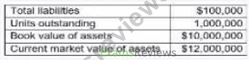
What is SKE fund's net asset value per share?
- A. $11, 90
- B. $12,00
- C. $10, 00
- D. $9,90
Answer: A
Explanation:
A white sheet with black text Description automatically generated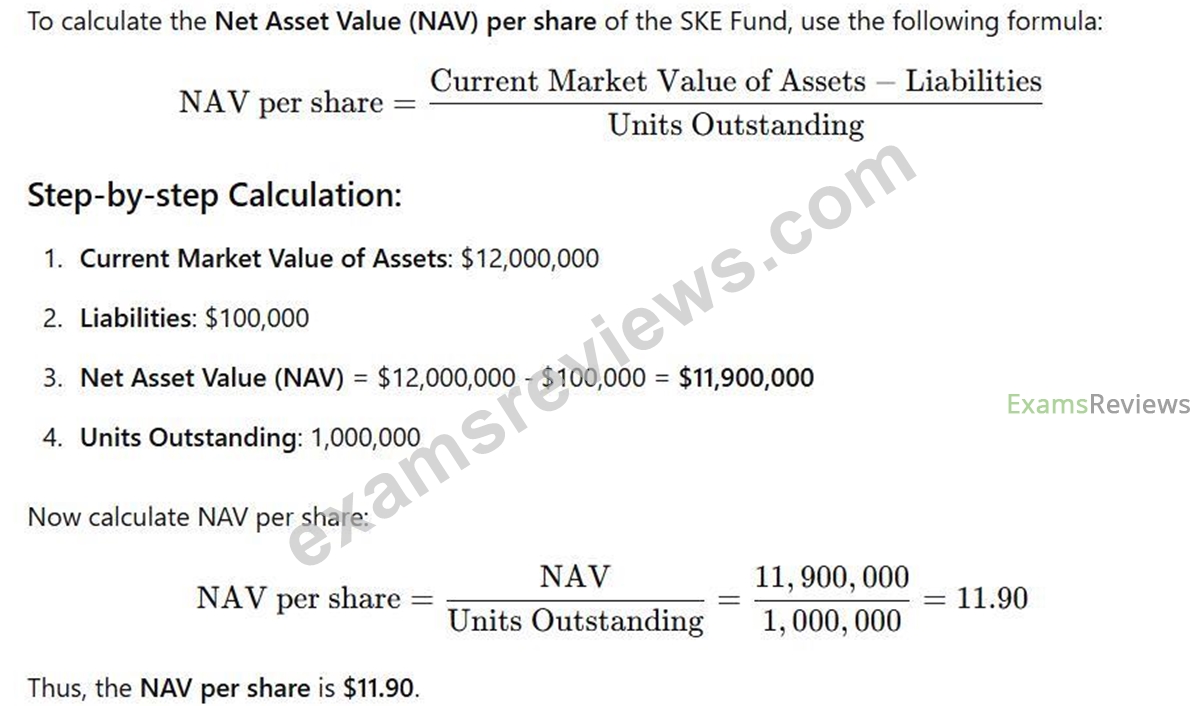
Explanation of Answer Options:
* Option A ($9.90): Incorrect; this value does not reflect the subtraction of liabilities.
* Option B ($11.90): Correct; it accounts for the subtraction of liabilities and proper division by outstanding units.
* Option C ($12.00): Incorrect; it represents the market value of assets per unit without deducting liabilities.
* Option D ($10.00): Incorrect; this value does not align with the given data or calculations.
References to Canadian Securities Course Exam 2 Study Materials:
* Volume 2, Chapter 17 - Mutual Funds: Structure and Regulation, Pricing Mutual Fund Units:
* Discusses the formula for calculating NAV per share, including the treatment of liabilities and market value of assets.
* Volume 2, Chapter 22 - Other Managed Products:
* Covers the concept of valuation for managed funds and its importance for accurate pricing.
* Volume 1, Chapter 11 - Corporations and Their Financial Statements:
* Provides foundational knowledge about book and market values used in calculations.
NEW QUESTION # 49
A young couple is looking to buy a house in the near future with a down payment. What type of investment should they consider for their portfolio?
- A. Corporate bonds
- B. Diversified balanced portfolio.
- C. Government Treasury bills
- D. Stable bank Stocks
Answer: C
Explanation:
For a young couple planning to buy a house in the near future, the primary investment consideration is safety and liquidity. Government Treasury bills (T-bills) are most suitable for the following reasons:
* Safety:
* T-bills are backed by the government and are considered virtually risk-free investments. For individuals seeking to preserve capital for a short-term goal like a home down payment, this feature is critical.
* Liquidity:
* T-bills are highly liquid instruments, allowing the couple to access their funds quickly if needed.
They trade in active secondary markets, ensuring that they can sell their holdings with minimal price impact.
* Short-Term Nature:
* T-bills have maturities ranging from a few days to a year, making them ideal for short-term investment horizons like a pending house purchase.
* Avoiding Risk:
* Investments like corporate bonds, bank stocks, or balanced portfolios carry higher risk due to potential market volatility or credit issues, which are unsuitable for a short-term goal.
References to Study Documents:
* Volume 1, Chapter 6, "Fixed-Income Securities: Features and Types," details the safety and liquidity of Treasury bills.
* Volume 2, Chapter 16, "The Portfolio Management Process," emphasizes aligning investment objectives with time horizons and risk tolerance.
NEW QUESTION # 50
Yusef is a high-net-worth individual who wants to diversify his portfolio with private equity but is concerned with the potential disadvantages of this asset class. What disadvantage should Yusef be considering as a potential private equity investor?
- A. Private equity typically provides lower long-term returns than other asset classes
- B. Private equity excludes investment from private debt
- C. Private equity is a high-risk investment
- D. Private equity companies are not listed on stock exchanges
Answer: C
NEW QUESTION # 51
......
Latest CSC2 Exam Dumps CSI Exam: https://www.examsreviews.com/CSC2-pass4sure-exam-review.html
Pass CSI CSC2 PDF Dumps Recently Updated 187 Questions: https://drive.google.com/open?id=1nelRKz_uK11zbI7_Kt5cflvF-F17QgJa